

Edition 49 | 2026 — When Agents Collide
✍️ by Amir Kabir | Founding Partner at Overlook VC

🧠 IN THIS ISSUE:
The Take: When Agents Collide
The Signal: Overlook Ventures x a16z Speedrun Investor Dinner
🔥 1. The Take — When Agents Collide
The risk conversations in 2026 have been almost entirely about what a single agent does wrong e.g. the hallucination, the bad output, or the model that fails in production.
The real problem is what happens when agents interact with each other.
As autonomous agents move beyond simple task execution to complex, cross-organizational negotiation, the primary threat to stability is emergent volatility. When disparate agents, each governed by unique reward functions and proprietary guardrails, collide in high-stakes environments like energy grids or global supply chains, they trigger recursive feedback loops and “synthetic” shocks that humans can neither predict nor easily pause.
Three things I’m tracking that aren’t getting enough attention:
The efficiency floor in unstructured agent negotiations is 30% worse than structured ones. Current research shows that when agents lack common protocols, they don’t fail but actually degrade. Quietly and recursively, at a speed no human oversight layer can match. That’s not a bug in any individual system.
Independent multi-agent systems amplify errors by 17.2x. Google Research tested 180 agent configurations and found that without a mechanism to check each other’s work, errors cascade unchecked.
Multi-agent coordination degrades performance on sequential tasks by 39–70%. The “more agents is better” assumption has a hard ceiling. On tasks requiring strict sequential reasoning, every multi-agent variant Google tested made things worse.
The performance gap is already documented. Research on multi-agent coordination shows a 64.47% success rate differential between agents operating with shared protocols versus those operating without them. That number shows the protocol gap, highlighting that the agents are capable., but the coordination layer doesn’t exist.
The supply chain case makes the inversion visible. LLM-based agents demonstrably reduce the bullwhip effect when they operate within structured negotiation frameworks. In unstructured environments, the dynamic reverses → a single miscoordinated agent doesn’t introduce noise, it propagates it. The tool designed to absorb volatility becomes its transmission vector.
In financial markets, the same cascade dynamic plays out at millisecond speed. Agents optimizing on incompatible reward functions produce defection loops and recursive feedback where the rational local move accelerates systemic instability. The system performs exactly as designed, while the design has no concept of the room it’s operating in.
At Overlook, we think the companies that define the next decade of enterprise AI infrastructure are building the coordination layer e.g the shared vocabulary, arbitration protocols, and trust-establishment infrastructure that determines whether a network of capable agents produces stability or systemic risk.
📡 2. Signal Watch — This Week in Risk
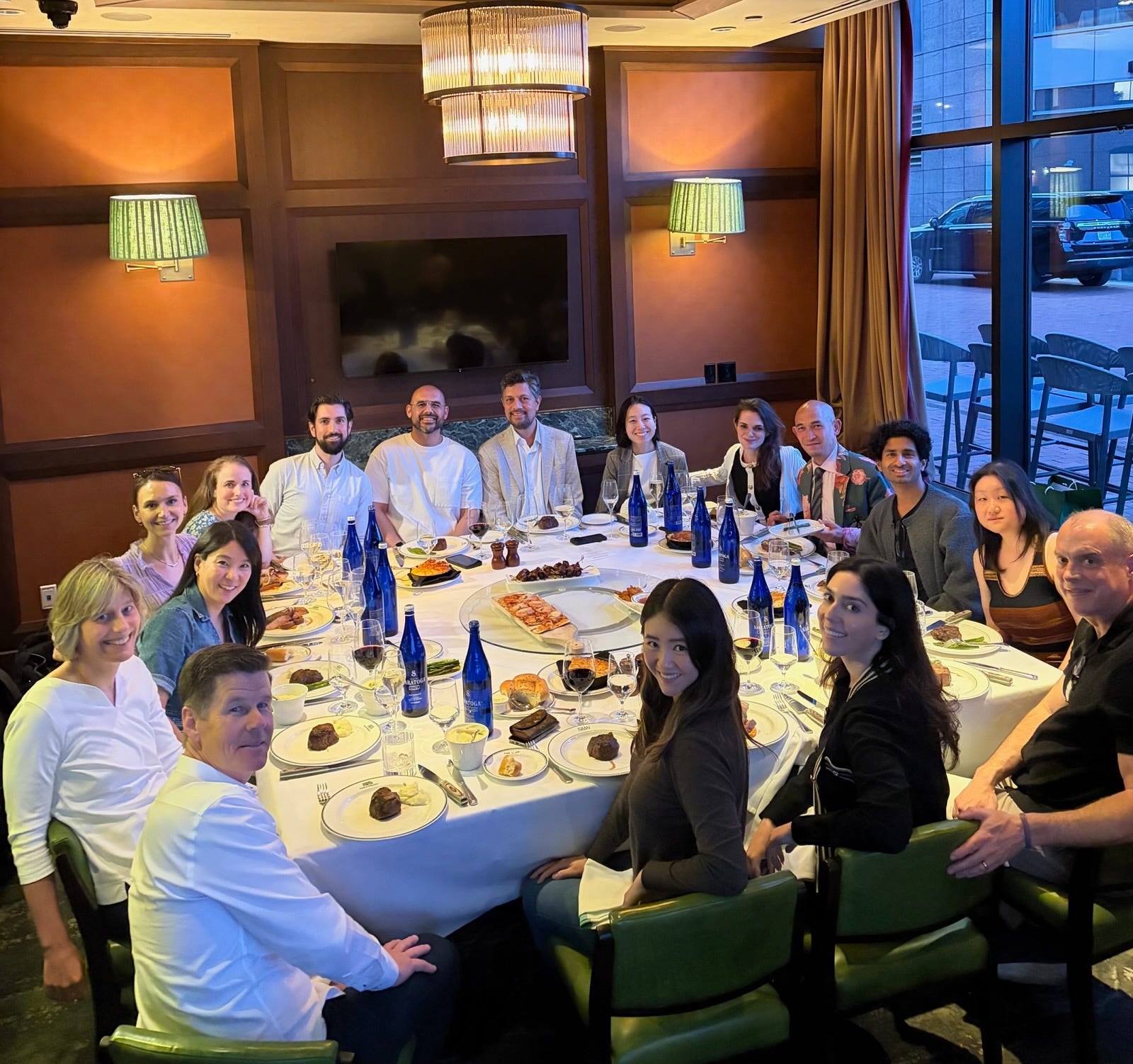
Sixteen people walked into a private room in Boston last night for the Overlook Ventures x a16z speedrun Investor Dinner during hashtag#BosTechWeek
These dinners are intentionally small - designed for depth over scale, with a single-thread conversation that sparks new ideas and real collaboration with no agenda, no pre determined topics and definitely no performative networking.
Just operators and investors debating what actually matters in AI right now.
A few themes repeatedly surfaced throughout the evening:
1. AI value is moving away from models and toward trust, distribution, and domain expertise.Building software has never been easier. Distribution, credibility, and customer understanding are becoming the real moats.
Agentic systems are creating a new category of liability and governance risk.
Who is responsible when an AI agent causes financial, operational, or safety failures? The industry still lacks a true trust and identity layer for cross-enterprise AI systems.
Robotics is real but hype and valuations may be ahead of reality.
Most agreed robotics will matter enormously. But many current companies still resemble research labs more than scalable businesses.
In regulated markets, “best technology” often loses to trust and distribution.
Being technically superior is not enough. The ability to navigate procurement, incentives, compliance, and organizational inertia is often the real edge.
The best founders and investors are historians.
Understanding why previous companies failed, where incentives broke, and how markets evolved remains one of the strongest forms of edge. One thing I particularly appreciated: many people around the table described themselves as operator-investors rather than pure financiers.
That distinction matters.
Huge thank you to everyone who joined us, and to Andreessen Horowitz, a16z speedrun, my dear friend Jacqueline Young and TECH WEEK by a16z for co-hosting.
Thank you also to the great crew at Smith & Wollensky Restaurant Group, Inc. Boston, David Cicciarella for taking care of us!
🔭 Coming Next Week
Topic: Synthetic Labor, Real Accountability
We’ll explore:
Replacing humans concentrates risk on firms.
— Amir
Founder, Managing Partner – Overlook VC
Twitter: @AmirKabir99 | 🔗 LinkedIn
🔗 Sign Up Executive Risk Dinners