

Edition 35 | 2026 — When Correlations Go to One
✍️ by Amir Kabir | Founding Partner at Overlook VC
🧠 IN THIS ISSUE:
The Take: When Correlations Go to One
The Signal: Permission > Capital: Bill Gurley on Careers, AI, and Conviction
The Builder: ProPay || Modern Infrastructure for Warranty Claims
🔥 1. The Take — When Correlations Go to One
We’ve spent decades building the layers of our world. Now, for the first time in history, those layers are talking to each other in the same language.
The breaking of old diversification models is clearing the way for a more intelligent, responsive, and hyper-efficient era of human progress.
However, we are also no longer living in a world of independent risks.
The New Architecture of the Stack
Asset Correlation: Diversification is becoming a legacy concept as the top 10 companies in the S&P 500 now command 40% of the index’s market cap, forcing global portfolios to move in a single, synchronized heartbeat tied to mega-cap AI growth.
Infrastructure Interdependence: The “distributed” web has collapsed into a physical oligopoly where the “Big Three” providers control 65% of the global cloud, creating a standardized utility that offers industrial-grade reliability but ensures a single kernel failure becomes a global cardiac arrest.
AI Model Monoculture: We are entering a “Universal Reasoning Standard” where over 80% of Fortune 500 companies leverage frontier model architectures (with caution and risk), allowing to automate cross-enterprise workflows at a scale once thought impossible.
Capital Concentration: Innovation has become a circular economy where a single hardware provider (Nvidia) holds an 86% market share in AI chips, funneling the world’s resources into building “Gigawatt-scale” data centers that only a handful of firms can afford to operate.
We have traded the safety of the “messy many” for a singular system of extraordinary power and extraordinary fragility.
The same integration that lets a solo founder wield the resources of a global corporation is the same integration that ensures a single point of failure echoes everywhere at once.
This is the defining tension of 2026 → Concentration at the infrastructure layer → Democratization at the application layer → And almost no independent risks in between.
In 2026, you don’t manage a portfolio, you navigate a singular, integrated machine.
📡 2. Signal Watch — This Week in Risk
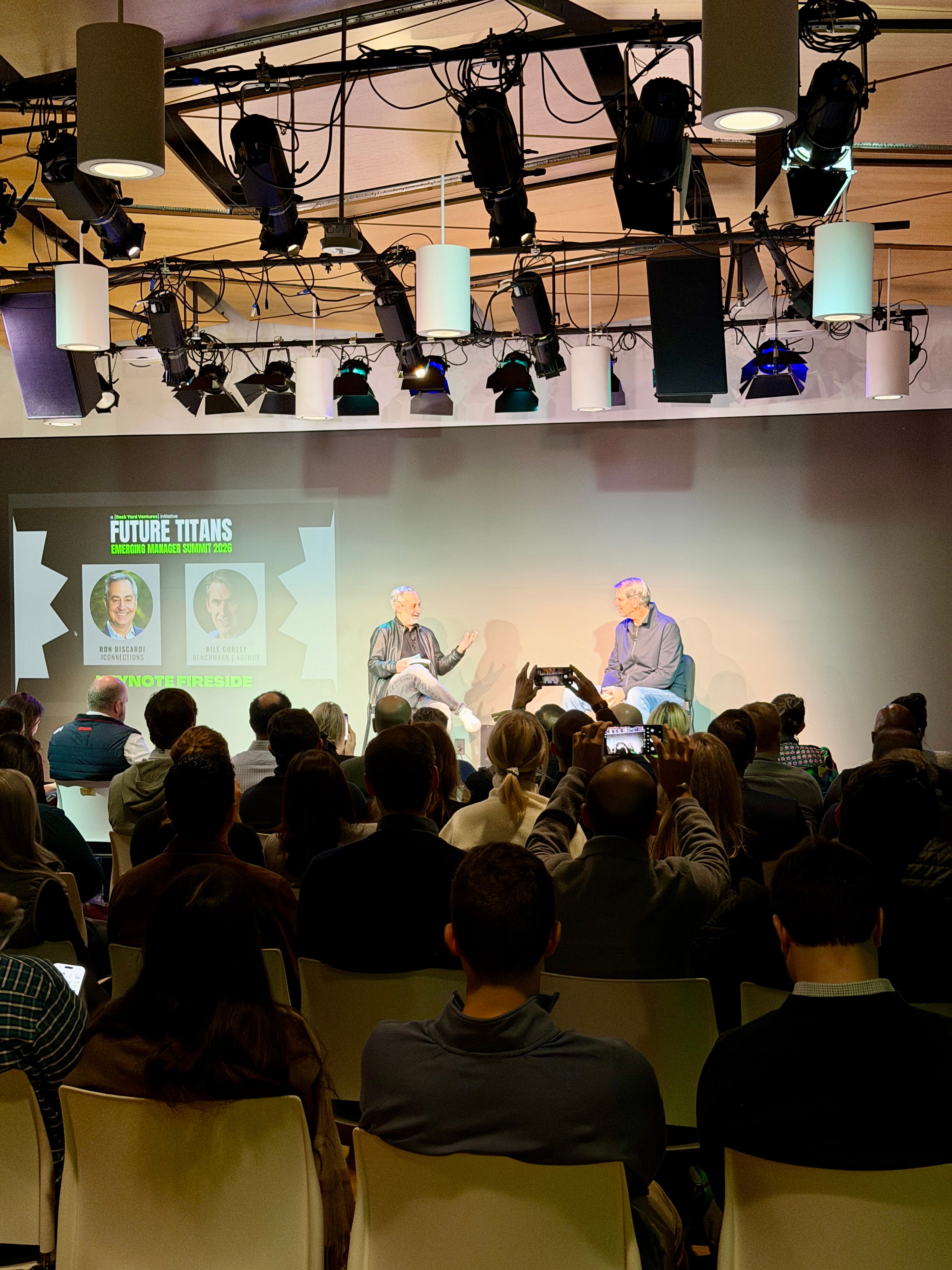
I sat in on a long-form conversation around Bill Gurley’s new book, Running Down the Dream, and his reflections on venture, careers, and AI and here are my biggest takeaways on how work, ambition, and capital are quietly being re-architected beneath the surface…
1️⃣ The real unlock isn’t capital. It’s permission.
Gurley’s core thesis is simple and uncomfortable: most people never give themselves permission to pursue what they actually want. They stay in lanes too long and they confuse “safe” with “correct.” Almost every outsized career he studied involved an early, intentional leap, often into paths parents would actively discourage.
2️⃣ Quitting is an under-taught skill.
Engineer → Wall Street analyst → Venture Capitalist. In each chapter of his own career, Gurley walked away once he realized this wasn’t the life he wanted. Modern systems train persistence, not discernment. But most people who “leave dents in the universe” pivot, repeatedly.
3️⃣ AI doesn’t eliminate competition. It intensifies it.
The idea that AI will create a no-work future? Gurley calls it nonsense. Costs haven’t disappeared. Burn rates are higher than ever. People are still the biggest line item, even at frontier AI labs. The edge isn’t avoiding AI. It’s learning to run with it.
4️⃣ This is a bubble — but bubbles are part of real disruption.
Dot-com: fake businesses. 2021 SaaS: real businesses, wrong prices. AI: real disruption + circular deals + speculation. When it breaks, it won’t invalidate AI, it’ll expose pricing, margins, and go-to-market illusions.
5️⃣ Go-to-market is still the most underrated weapon.
Every breakout company Gurley points to had an unfair advantage in distribution. Just tech and just vision are not enough. A deep, earned understanding of how customers are actually reached and convinced.
My biggest takeaway:
The future doesn’t belong to people who play it safe or wait to be chosen.
It belongs to people who give themselves permission, then work relentlessly to earn it.
🚀 3. Founder Focus — Who’s Building in the New Risk Economy?
Each week, I’ll spotlight one company solving a “hard risk” problem.
This Week: ProPay
🚨 Problem: Warranty claims (starting with home warranty) are manual, fragmented, and slow. Long cycle times, costly human review, and unnecessarily high severity create operational drag, harm retention for providers, and reduce profitability for technicians.
🔬 Solution: ProPay builds an AI-powered claims administration layer that automates the End to End claims workflow from FNOL to payment. It reduces truck rolls by triaging claims and predicting repairs at the serial number level, automates submission across legacy portals, streamlines parts procurement, and enables instant or next-day payments for pros.
👨🔬 Team: Second time founder with deep warranty/service network experience and industry relationships for distribution and pilots.
📈 Why it matters: Warranty is a $155B market with broken infrastructure. If ProPay becomes the system of record for claims and embeds factoring, it captures both workflow control and transaction monetization, compounding data advantage over time.
🔭 Coming Next Week
Topic: The Silent Repricing of Duration
We’ll explore:
Long-term assumptions are being quietly challenged
— Amir
Founder, Managing Partner – Overlook VC
Twitter: @AmirKabir99 | 🔗 LinkedIn
🔗 Sign Up Executive Risk Dinners